Today, a different tourism proposition is emerging, one built around luxury hospitality, international brands, branded residences, wellness, entertainment and integrated destinations.
Egypt has traditionally sold itself to the world through its history, archaeology, and Red Sea resorts.
Today, a different tourism proposition is emerging, one built around luxury hospitality, international brands, branded residences, wellness, entertainment and integrated destinations.
The country is building a broader destination identity that combines heritage, coastal experiences, adventure, wellness, nature and luxury, with the ambition of encouraging travelers not only to visit once, but to return for different experiences.
A traveler arriving at one of Egypt’s emerging coastal destinations may no longer be offered simply a hotel room and a beach.
The proposition can extend to branded apartments, fine dining, retail, wellness facilities, entertainment, sports, nightlife and even property ownership, all within the same master-planned ecosystem.
The shift is visible in the numbers
Egypt welcomed about 19 million tourists in 2025, a 21 percent increase from 2024, according to the Ministry of Tourism and Antiquities.
Meanwhile, tourism revenues reached $16.7 billion in FY2024/25, up 16.3 percent, as tourist nights climbed to 179.3 million.
Tourist arrivals are projected to rise another 6.3 percent in 2026 to around 20.19 million, according to BMI, a Fitch Solutions company, in a report highlighted by Egypt’s Cabinet Information and Decision Support Center.
Arrivals are forecast to reach 23.78 million by 2030, representing average annual growth of 4.6 percent, while tourism revenues are projected to increase from an estimated $18.58 billion in 2026 to $21.15 billion by 2030.
A new tourism map
Cairo, Luxor and Aswan remain the anchors of cultural tourism, while Sharm El Sheikh, Hurghada and other Red Sea destinations have long established Egypt as a major sun-and-sea market.
But the development story is broadening.
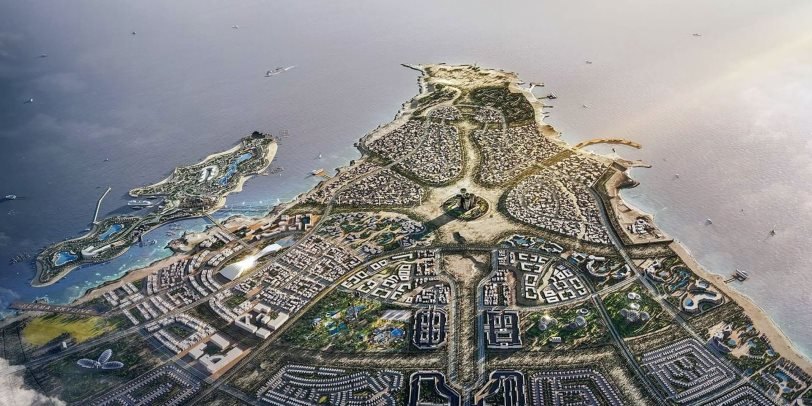
Along the Mediterranean, the North Coast is evolving from a predominantly domestic summer destination into a much larger hospitality and real-estate market. New Alamein, Ras El Hekma and other coastal developments are attracting hotels, residences, restaurants and entertainment concepts alongside the second-home market.
Official tourism strategy is increasingly treating the North Coast as an international product rather than simply a summer escape for Egyptians. The Tourism Ministry has spoken of connecting it with Alexandria and Siwa to create a wider Mediterranean itinerary, while rising international demand has pushed hotel capacity and air connectivity higher on the agenda.
The Red Sea presents a different opportunity. Destinations including Hurghada, Sharm El Sheikh, Marsa Alam, Soma Bay and El Gouna already combine international tourism, resort infrastructure and marine activities, giving the coast stronger foundations for year-round leisure, wellness and premium hospitality.
Greater Cairo is simultaneously expanding beyond the traditional heritage-business tourism mix. New Cairo, West Cairo and the New Administrative Capital are attracting global hotel operators alongside residential, retail and office developments.
Luxor and Aswan, meanwhile, offer perhaps the clearest example of the potential to add value without changing the underlying attraction. Ancient monuments remain the reason to go, but higher-end hotels, Nile cruises, gastronomy, curated cultural experiences and longer itineraries can change the economics around the visit.
“Egypt has the potential to develop several tourism products that remain underutilized, including sports, yacht, conference and entertainment tourism. Developing these segments, alongside medical tourism, could help diversify Egypt’s offer and strengthen its ability to compete with destinations such as Turkey, Spain and France,” Tourism and Hotel Expert Khaled Helmy said in an interview with Business Today Egypt.
The result is a tourism map increasingly built around ecosystems rather than isolated attractions.
Recently, Prime Minister Mostafa Madbouly reiterated the government’s focus on developing Egypt’s Northwest Coast, in line with President Abdel Fattah El-Sisi’s directives to implement an integrated development strategy that maximizes the region’s significant potential.
The plans extend beyond tourism development, with a broader vision to establish new urban, economic and productive communities along the coastline, while attracting greater investment across a wide range of sectors.
“Egypt already has exceptional heritage, beaches and established resorts. The bigger opportunity is to make these strengths easier to experience within a single trip. Visitors should be able to combine Cairo with the Red Sea or the North Coast through clear and convenient itineraries," Ahmed Sayed, Finance Director, Tourism Sector; Director of Finance, Tez Tourism and T.E.Z Egypt said in an interview with Business Today Egypt.
"There is also room to expand conferences, yachting, water sports, wellness, and local food and cultural experiences. Ultimately, the quality of the complete trip is what encourages longer stays and repeat visits,” Sayed added.
Real estate is reshaping the North Coast
Tourism investment and a new generation of large-scale real-estate developments designed as fully integrated cities, rather than seasonal compounds, are driving the transformation of Egypt's North Coast.
“Egypt has the natural and human resources to become one of the world’s leading tourism markets, and the development of new destinations such as the North Coast, Ras El Hekma and Alam El Roum is an important step in that direction. The success of New Alamein and destinations such as Marassi has already attracted strong interest from Gulf markets," Tourism and Hotel Expert Khaled Helmy said in an interview with Business Today Egypt.
Helmy added that the North Coast has the potential to become a global, year-round destination rather than a primarily summer market.
He said that its beaches and natural assets give it the potential to compete with established destinations such as Hurghada, Sharm El Sheikh and Marsa Alam. Overcoming seasonality will require more hotel capacity, international marketing, improved air connectivity and greater coordination across the tourism ecosystem. As investment in the region grows, it can increasingly attract visitors from a wider range of international markets.
Ras El Hekma is the clearest example. The masterplan covers about 170 million square metres and Modon Holding is developing it following ADQ’s $35 billion investment agreement with Egypt.
Hospitality is already becoming central to that model. In 2026, Modon announced Montage Ras El Hekma, combining a 200-key luxury resort with 96 branded residences, alongside wellness, dining, retail and leisure facilities.
The project illustrates how the North Coast is moving beyond conventional second-home development toward a model in which tourism, property ownership and hospitality operate within the same ecosystem.
Further west, Alam Al-Roum is emerging as another major test of the integrated-destination model. The project, being developed through a partnership between Qatari Diar and Egypt’s New Urban Communities Authority, spans around 4,900 feddans and 7.2 kilometres of Mediterranean coastline. Total planned investment has been reported at around $29.7 billion.
Its masterplan goes well beyond residential development. It includes hotels, marinas, golf, wellness, retail and town centres, alongside educational and service facilities, with the stated aim of creating a destination that functions throughout the year rather than only during the summer season.
“The key measure of these new developments is not simply their scale, but whether they can attract visitors who stay longer, spend across different activities and have reasons to return,” Finance Director at Tourism Sector Sayed said.
“Ras El Hekma and Alam Al Roum have the potential to become year-round international destinations, but building homes and opening hotels will not be enough," he said.
Sayed added that the North Coast already has strong summer demand; the real test is creating reasons for visitors to come during the rest of the year through events, conferences, sports, food and cultural experiences, supported by reliable flights and services.
The destination can be viable without matching its summer peak in winter, but if success is measured only by property sales, it may succeed as a real-estate project without becoming a truly international tourism destination.
Health and wellness could broaden Egypt’s tourism offer
Egypt is also looking beyond conventional leisure tourism by expanding its medical and wellness offering, adding another layer to its broader push to diversify the country’s tourism economy.
Bloomberg has highlighted Egypt’s growing ambitions in medical tourism, pointing to the country’s geographic position, expanding hospitality sector and efforts to combine healthcare with cultural and leisure experiences.
Luxor, Aswan and the Red Sea are among the destinations being positioned at the center of that strategy, as Egypt seeks a larger share of a global medical tourism market estimated at around $34 billion.
The segment is already gaining traction. Egypt’s General Authority for Healthcare said in August 2026 that medical tourism revenues had exceeded $10 million, with nearly 42,000 international patients treated across its facilities.
The opportunity extends beyond healthcare itself. By combining treatment with hotels, transport, dining, wellness and tourism experiences, medical and wellness travel could help Egypt attract a different type of visitor, encourage longer stays and generate more value from each trip.
For Egypt, the goal is not simply to add healthcare to the tourism offer, but to turn health and wellness into a reason to travel to the country in the first place.
Beyond the pyramids, but not without them
None of this means Egypt is moving away from heritage.
The opposite may be true. The opening of the Grand Egyptian Museum has strengthened one of the country's oldest tourism advantages just as new hospitality, coastal, and lifestyle developments expand the reasons to stay.
Official figures show a 30 percent increase in ticket sales at archaeological sites and museums in 2025, while the Grand Egyptian Museum received around 15,000 visitors a day in early 2026.
The pyramids are not the old product that needs replacing. They are an advantage no competing lifestyle destination can reproduce.
Egypt's opportunity is therefore not to choose between archaeology and beaches, or between heritage and luxury. It is to connect them.
That means creating a tourism economy in which a visitor can come for ancient history and stay for contemporary hospitality; travel for the Red Sea and return for wellness; discover the North Coast and eventually buy a home; or visit Cairo and extend the trip into a wider journey through the country.
The challenges behind the opportunity
Yet turning Egypt’s expanding tourism pipeline into a higher-value, globally competitive sector will depend on more than new hotels and large-scale developments. Access, service quality, workforce capacity and the protection of natural assets remain key challenges, particularly as Egypt seeks to attract higher-spending travelers and encourage longer stays.
Ahmed Sayed, Finance Director, Tourism Sector and Director of Finance at Tez Tourism and T.E.Z Egypt, said Egypt’s biggest challenges in developing higher-value tourism are air connectivity, consistent service and protecting natural assets.
“Egypt needs to focus on reliable international air links, a broader range of experiences and trusted service standards, while protecting its natural resources. Visitor numbers matter, but so do length of stay, spending and the benefits reaching local businesses and communities,” Sayed added.
He added that addressing these priorities would help Egypt compete on the quality of the experience rather than price alone.
Tourism expert Helmy confirmed that one of Egypt’s biggest challenges is improving tourism culture, service standards and infrastructure. Reaching 30 million visitors will require more hotel capacity, better-trained tourism workers and stronger, more affordable air connectivity with international markets. Retaining skilled professionals is equally important, as service quality ultimately depends on the people delivering it