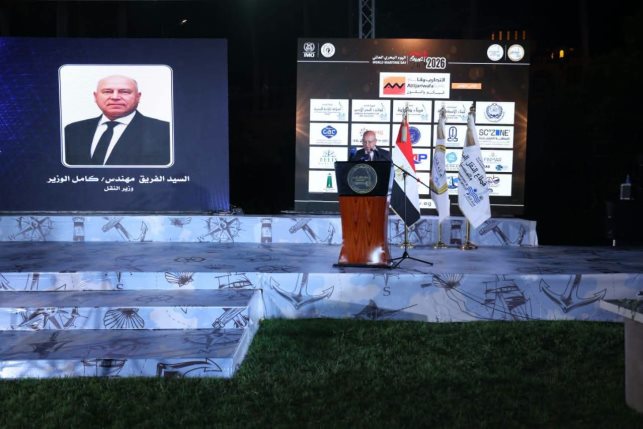
Speaking during the World Maritime Day 2026 celebrations, El-Wazir said the government is implementing a comprehensive program to upgrade ports, infrastructure, and logistics services in line with international standards.
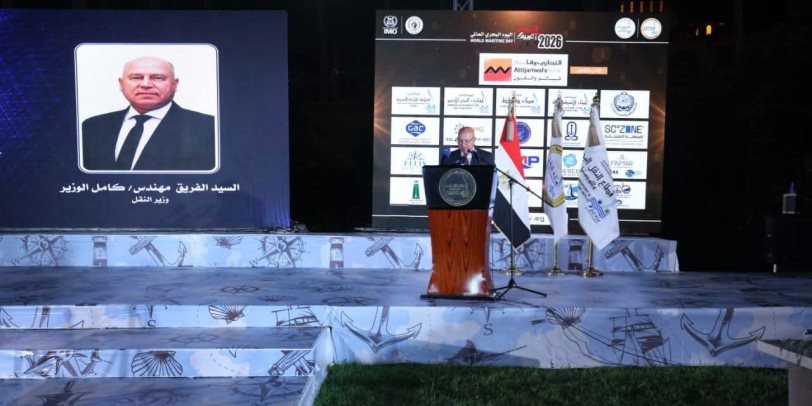
Kamel El-Wazir, Minister of Transport, said Egypt has placed significant emphasis on developing its maritime sector as a key pillar of economic growth and its strategy to position the country as a regional hub for transport, logistics, and transit trade.
Speaking during the World Maritime Day 2026 celebrations, El-Wazir said the government is implementing a comprehensive program to upgrade ports, infrastructure, and logistics services in line with international standards.
As part of the strategy, Egypt is developing eight integrated international logistics corridors connecting ports on the Red Sea and Mediterranean, as well as the Suez Canal axis, with dry ports and industrial, agricultural, and mining areas.
The corridors are supported by Egypt’s railway network, high-speed electric rail system, and major highways and expressways, with the aim of reducing cargo handling times and costs, strengthening the competitiveness of the Egyptian economy, and enhancing connectivity with the Gulf states, the Levant, Africa, northern, eastern and central Europe, and Asia.
The maritime transport development plan also seeks to transform Egyptian ports into fully integrated logistics hubs while expanding and upgrading facilities on both the Red Sea and Mediterranean.
The plan includes the construction of five new ports, bringing the total number of commercial ports to 19, while expanding their combined area to 100 million square meters. Egypt is also adding 70 kilometers of new berths, with depths ranging from 18 to 25 meters, bringing the total berth length to more than 100 kilometers.
In addition, 35 kilometers of breakwaters are being constructed, raising the total to 50 kilometers, alongside upgrades to navigation channels and the marine tugboat fleet, which is expected to reach 80 tugboats with bollard pull capacities of 70–90 tonnes.
El-Wazir said Egyptian ports recorded strong growth in 2025, handling 233 million tonnes of cargo, an increase of 12 percent year-on-year. Container throughput reached 11.1 million TEUs, up 25 percent compared with the previous year, despite geopolitical challenges in the region.
New investments have also been directed toward container and multipurpose terminals, with opportunities offered to international shipping lines and global operators to develop infrastructure and operate the facilities. Egypt has also entered into agreements with international alliances to manage and operate newly developed terminals.
The minister added that Egypt advanced to 19th globally on the Liner Shipping Connectivity Index (LSCI), up from 23rd place in 2024, ranking first in Africa and second in the Arab world.
Egypt aims to enter the global top 15 by 2030, supported by continued infrastructure development, increased operational capacity, and efforts to attract more international shipping lines.
As part of efforts to strengthen the Egyptian commercial fleet, the Ministry of Transport is implementing a plan to expand it to around 40 commercial vessels by 2030, capable of transporting 30 million tonnes of cargo annually through its affiliated companies.
El-Wazir also reaffirmed Egypt’s commitment to international maritime conventions and International Maritime Organization instruments, alongside efforts to modernize legislation, strengthen institutional capabilities, train maritime professionals, and adopt advanced digital systems.
He added that Egypt continues to cooperate with the IMO, participate in its Council and technical committees, and submit initiatives and technical documents, efforts that culminated in Egypt’s election to the IMO Council.