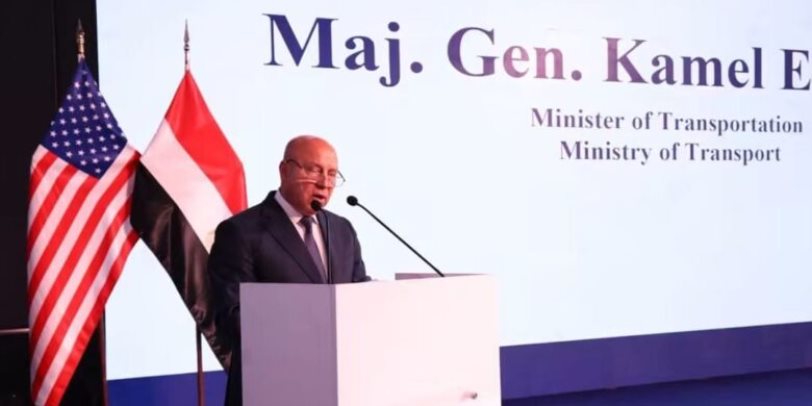
Egypt is looking to expand cooperation with U.S. companies in maritime transport and port operations as part of efforts to strengthen the competitiveness of its ports and attract more transit trade, Minister of Transport Kamel Elwazir said on Sunday.
Speaking at the U.S.–Egypt Ports Infrastructure and Maritime Innovation Forum in New Cairo, Elwazir said Egypt has successfully established strategic partnerships with major global port operators and shipping lines, enhancing the ability of Egyptian ports to attract transit trade and compete globally.
He expressed Egypt’s interest in expanding partnerships with U.S. companies in the sector, highlighting the strategic importance of maritime transport to bilateral economic cooperation.
Elwazir said the forum reflects the depth of Egyptian-U.S. relations, which extend beyond trade and investment to an established strategic partnership capable of supporting growth, stability and development.
He noted that maritime transport represents a key area of cooperation given Egypt’s strategic geographic location, the Suez Canal, developed ports and logistics zones, while the U.S. brings advanced expertise in transportation, logistics and supply chains.
The two countries share a vision focused on improving the efficiency, sustainability and security of global supply chains, while increasing private-sector participation in projects aimed at localizing technology, developing maritime and logistics services and enhancing port competitiveness, Elwazir said.
Egypt developing eight integrated logistics corridors
Elwazir said Egypt is currently implementing eight integrated international development logistics corridors connecting Red Sea and Mediterranean ports and the Suez Canal axis with dry ports and industrial, agricultural and mining zones through railway networks, high-speed electric trains and highways.
The corridors are expected to reduce the time and cost of transporting goods while strengthening Egypt’s position as a regional hub for transport, logistics and transit trade.
The eight corridors are:
* Arish–Taba
* Sokhna–Alexandria
* Safaga–Qena–Abu Tartour
* Cairo–Alexandria
* Tanta–Mansoura–Damietta
* Gargoub–Salloum
* Cairo–Aswan–Abu Simbel
* Bernice–Aswan–East Oweinat–Al Kufra–N'Djamena
The corridors offer broad opportunities for U.S. cooperation and investment in transportation, logistics, mining, industry and infrastructure, Elwazir said.
He particularly highlighted the Arish–Taba and Sokhna–Alexandria corridors, saying they could support Egypt’s potential integration into the India–Middle East–Europe Economic Corridor (IMEC).
Elwazir stressed that Egypt is prepared to play a role in the corridor given its developed infrastructure, ports and industrial and economic zones.
Egypt targets 19 commercial ports
The minister said Egypt’s maritime transport strategy aims to transform its ports into integrated logistics hubs connected to various transportation networks, reducing cargo clearance and handling times, lowering costs and improving the efficiency of imports and exports.
The strategy includes developing ports on the Mediterranean and Red seas and establishing five new ports, bringing the total number of commercial ports to 19.
The plan also targets expanding port areas to around 100 million square meters, adding approximately 70 kilometers of new berths, and upgrading navigation barriers and marine tugboat fleets.
Egypt is also working to expand its national maritime fleet to 40 vessels by 2030, with a transportation capacity of 30 million tons annually, Elwazir said.
In parallel, the government is implementing green maritime transport projects, expanding the use of clean energy, reducing carbon emissions and applying international environmental standards across Egyptian ports.
Elwazir affirmed the government’s readiness to provide support for serious investments, particularly from U.S. companies, across transportation sectors, with maritime transport among the key areas.
“The future of this sector is based on partnership, integration and the exchange of expertise,” Elwazir said, expressing his hope for broader Egyptian-U.S. cooperation that supports shared prosperity and the sustainability of global trade.