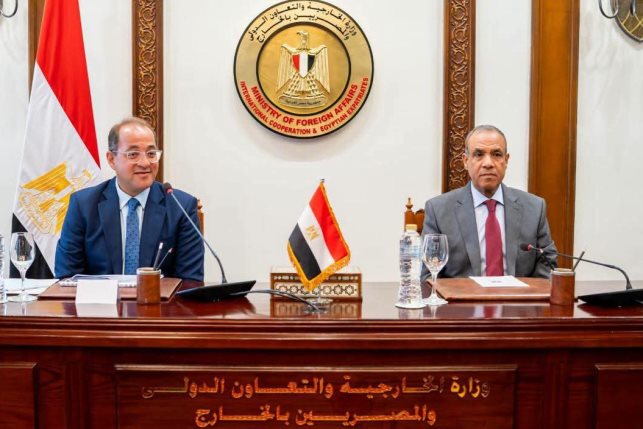
Speaking during an open dialogue with the heads of Egypt’s diplomatic missions abroad, attended by Foreign Minister Badr Abdelatty, Kouchouk said international investors had renewed their confidence in the country’s economic trajectory.
Egypt’s economy is showing early signs of improvement, with the private sector expanding its role to account for 60% of total investments, Minister of Finance Ahmed Kouchouk said.
Speaking during an open dialogue with the heads of Egypt’s diplomatic missions abroad, attended by Minister of Foreign Affairs, Emigration and Egyptian Expatriates Badr Abdelatty, Kouchouk said international investors had renewed their confidence in the country’s economic trajectory.
He added that investors had responded positively to recent economic reforms, lowering their assessment of Egypt’s investment risk to its lowest level since 2014. Kouchouk called on Egyptian diplomatic missions to support efforts to attract further investment flows and promote the country’s economic opportunities internationally.
The finance minister highlighted strong activity across several sectors, including manufacturing, information and communications technology, and tourism. He said this growth reflected genuine investor confidence, stressing that investment decisions are ultimately driven by commercial prospects.
Kouchouk outlined four priorities guiding the government’s economic policy: strengthening confidence among private-sector investors and financiers, stimulating economic activity, reducing public debt, and increasing spending on healthcare, education and social protection.
He said the government views investors as development partners and aims to help businesses expand through additional tax and customs incentives.
Egypt is also working to broaden its industrial, productive and export base to enhance the economy’s competitiveness, according to Kouchouk. He pointed to significant opportunities for expanding service exports, supported by Egypt’s young workforce and its ability to compete in international markets.
The minister also revealed that preliminary tax revenues due for 2024 following the implementation of the Competitive Neutrality Law reached LE 67.4 billion.
The meeting formed part of broader coordination between the finance and foreign ministries to strengthen Egypt’s economic diplomacy. Abdelatty and Kouchouk discussed how the country’s overseas diplomatic missions could support national economic and financial priorities.
The discussions focused on promoting investment and trade opportunities, strengthening engagement with international financial institutions and business communities, attracting foreign investment, expanding exports and opening new markets for Egyptian products.
The meeting also gave newly appointed Egyptian ambassadors an overview of the government’s fiscal and economic priorities, as well as its reform efforts and the opportunities available for international cooperation and investment.