This step comes as part of the Authority’s comprehensive strategy to develop and advance the non-banking financial sector, which focuses on building qualified human capital capable of keeping pace with rapid transformations in financial markets, enhancing institutional efficiency, supporting market stability, and protecting the rights of stakeholders.
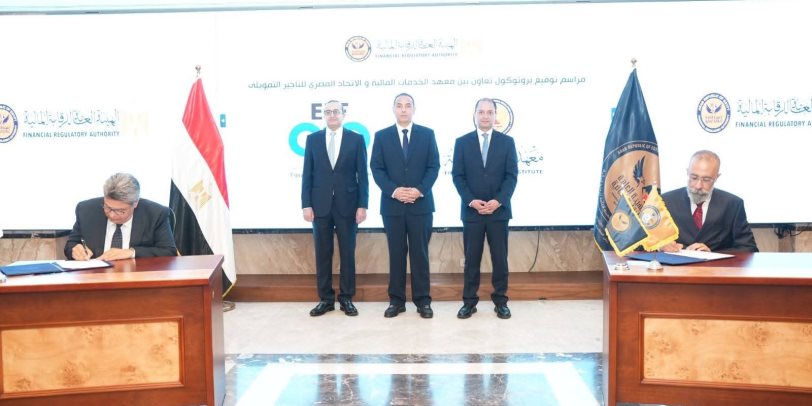
Islam Azzam, Chairman of the Financial Regulatory Authority (FRA), witnessed the signing of several cooperation protocols between the Financial Services Institute and the Egyptian Federation for Mortgage Finance, the Egyptian Leasing Federation, the Egyptian Consumer Finance Federation, and the Egyptian Factoring Federation.
This step comes as part of the Authority’s comprehensive strategy to develop and advance the non-banking financial sector, which focuses on building qualified human capital capable of keeping pace with rapid transformations in financial markets, enhancing institutional efficiency, supporting market stability, and protecting the rights of stakeholders.
Azzam emphasized that these protocols represent a continuation of the Authority’s efforts to invest in human capital as the primary driver of growth and development in the non-banking financial sector.
He added that building the capabilities of the workforce is no longer optional but a necessity driven by the rapid changes in non-banking financial activities, particularly following the accelerated growth in financial technology, which must be accompanied by continuous expansion in financial literacy and skills development.
Azzam further noted that the Authority provides an integrated educational and training environment through effective partnerships with professional and training institutions locally and internationally.
These efforts aim to prepare advanced professionals capable of applying the highest standards of efficiency and governance, while strengthening investor and stakeholder confidence in non-banking financial markets.
He also highlighted the Authority’s ongoing efforts to develop regulatory and training frameworks that support the sector, enhance its attractiveness to investments, and achieve sustainable growth rates, within an integrated vision aimed at improving market efficiency and strengthening its role in supporting the national economy.
Azzam pointed out that expanding specialized training programs aligned with actual market needs contributes to improving the quality of services provided and supports the state’s efforts to achieve financial inclusion and empower different segments of society to access innovative and secure financial services.
The protocols were signed on behalf of the Authority by Dr. Tarek Seif, who explained that these partnerships with non-banking financial activity federations reflect the integration of roles between regulatory and professional entities to develop human competencies within these vital sectors.
He noted that the agreements also represent an important step toward aligning training programs with real market requirements and narrowing the gap between academic knowledge and practical applications in the non-banking financial sector.
He added that the Institute is working to develop its programs to enable the transfer of practical expertise to targeted professionals based on evolving needs, sector sizes, and the number of beneficiaries, while leveraging the experience of market practitioners within the training system to more effectively enhance workforce qualification.
The protocols aim to maximize the use of practical expertise and provide outstanding professionals from member companies within the federations the opportunity to join the Institute’s training system as accredited lecturers, subject to passing technical evaluations. This approach ensures the transfer of applied knowledge and enhances the quality of training programs.
Areas of cooperation also include developing flexible training plans that respond to the needs of federations and companies, offering incentive-based benefits to members, and continuously updating training content to reflect market developments.
The Authority continues its efforts to advance professional training and qualification through the Financial Services Institute by designing and implementing specialized programs that cover various non-banking financial activities.
These programs focus on governance, risk management, financial innovation, and digital transformation, in line with international best practices and aimed at enhancing the competitiveness of the Egyptian market regionally and globally.
Previously, the Authority signed cooperation protocols with academic and specialized training institutions to develop advanced training programs and build the capacities of professionals in non-banking financial activities by preparing qualified talent and continuously updating training content in line with global standards.