Madbouly said the government remains committed to backing industrial investment through upgraded infrastructure, targeted incentives, and measures aimed at increasing production and exports.
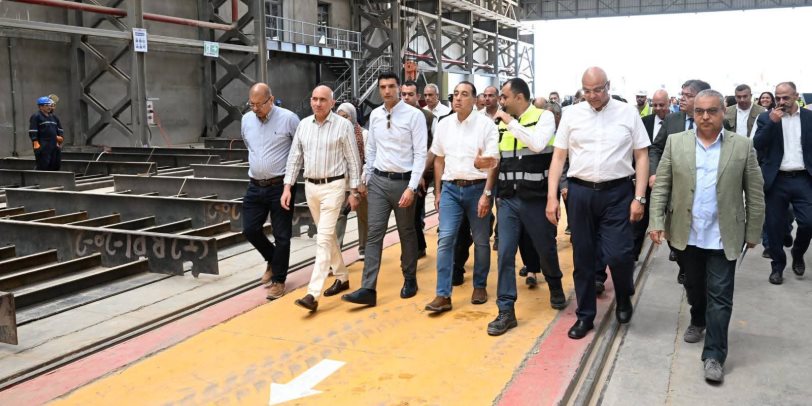
Prime Minister Mostafa Madbouly inaugurated and inspected a number of major industrial and infrastructure projects in Alexandria on Sunday, as Egypt steps up efforts to expand local manufacturing, attract export-oriented investments, and strengthen foreign currency inflows.
The tour covered several key projects, including the opening of the Jade Textile ready-made garments factory, the launch of the first phase of the Gharably Industrial Complex, the latest expansion of Shahinler Egypt 2, a new production line at Lipton Teas and Infusions Egypt, and an inspection of Alstom’s railway manufacturing complex in New Borg El Arab City.
Together, the projects support more than 20,700 direct jobs and are expected to generate hundreds of millions of dollars in exports, reflecting the government’s focus on textiles, engineering industries, transport equipment, and consumer goods as key drivers of industrial growth.
Madbouly said the government remains committed to backing industrial investment through upgraded infrastructure, targeted incentives, and measures aimed at increasing production and exports.
Among the largest projects inaugurated was the Jade Textile factory, owned by Turkey’s Yeşim Group. The company employs more than 15,000 workers across its facilities in Alexandria, Ismailia, and 10th of Ramadan City. Investment in the Alexandria facility stands at nearly EGP 500 million, while annual exports are expected to range between $250 million and $500 million.
The Prime Minister also inaugurated the latest expansion of Shahinler Egypt 2, owned by Turkey’s Shahinler Holding Group. The expansion added 32 new production lines, creating 1,500 direct jobs and around 4,500 indirect jobs, with exports projected to reach nearly $55 million in 2026.
In the engineering sector, Madbouly inaugurated the first phase of the Gharably Industrial Complex, a steel fabrication and engineering hub with an annual production capacity exceeding 100,000 tons. The complex currently employs around 3,000 workers, with plans to increase its workforce to 5,000 in future phases. It is designed to serve major infrastructure projects, including ports, transport corridors, and industrial developments.
Madbouly also inspected Alstom’s industrial complex, one of the key projects under Egypt’s railway localization programme. The project includes a factory for electrical railway systems and another for rolling stock production, including metro trains, trams, light rail vehicles, monorails, and high-speed trains. The facilities are expected to create around 950 jobs.
Transport Minister Kamel Al-Wazir said the project supports Egypt’s plan to localize railway manufacturing and position the country as a regional production hub serving markets across the Middle East and Africa.
The tour also included the inauguration of a new production line at Lipton Teas and Infusions Egypt’s factory in Borg El Arab. The facility produces brands including Lipton Yellow Label and Brooke Bond, with an annual production capacity of 25,000 tons and a workforce of 273 employees. Company officials said Lipton plans to export around 25 percent of local production to regional markets, with the first shipment from the factory to Australia scheduled for this week.
On the infrastructure side, Madbouly inspected the Lieutenant General Omar Suleiman Axis, the western arc of Alexandria’s ring road. The 20-km corridor links the Cairo-Alexandria Desert Road with Alexandria International Airport, Borg El Arab City, and the northwestern coast.
Housing Minister Randa El-Menshawy said the project is part of the state’s efforts to upgrade transport infrastructure and improve connectivity between major road networks, industrial zones, and logistics hubs.
According to the Central Agency for Reconstruction, the corridor includes a dual carriageway with six lanes in each direction, four flyovers, two bridges over the high-speed electric rail line, five bridges over waterways, and the covering of the Palestine Drain for 2.3 km to improve traffic flow and infrastructure services.
Alexandria Governor Ayman Attia said the governorate has implemented or is currently carrying out 94 strategic projects worth a combined EGP 402 billion since 2014, covering industrial, transport, and infrastructure development.
The projects come as part of Egypt’s wider industrial localization strategy, which aims to reduce import dependence, increase domestic production, and boost exports in strategic sectors. Officials say the combination of industrial investment, export-led manufacturing, and major infrastructure upgrades will help strengthen Egypt’s position as a regional production and logistics hub while creating jobs and supporting foreign currency earnings.