At the outset of the meeting, the minister praised the long-standing partnership with the Islamic Development Bank Group and its role in financing projects with strong developmental impact.
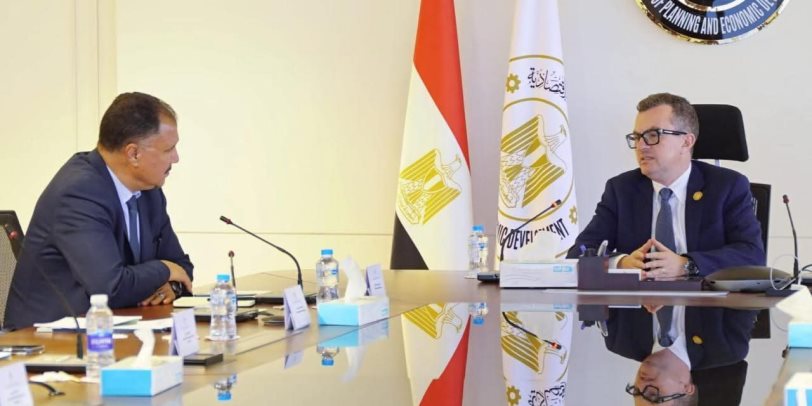
Ahmed Rostom, Minister of Planning and Economic Development and Egypt’s Governor at the Islamic Development Bank Group, met with Noureddine Mabrouk, Regional Director of the Bank’s Cairo office, to discuss prospects for future cooperation and ways to strengthen the partnership in support of Egypt’s economic development priorities.
At the outset of the meeting, the minister praised the long-standing partnership with the Islamic Development Bank Group and its role in financing projects with strong developmental impact.
He emphasized the importance of a shared vision aimed at promoting sustainable growth and supporting institutional modernization efforts, contributing to comprehensive development and improving citizens’ quality of life.
Rostom highlighted the government’s aspiration to build on the successes achieved through ongoing cooperation and expand into new areas that align with national priorities.
He noted that the partnership with the Bank has delivered tangible results across several vital sectors, enhancing the competitiveness of the Egyptian economy and supporting more sustainable and inclusive growth.
The minister also underscored the importance of international financial institutions adopting more flexible policies amid rapidly evolving global challenges, enabling countries to adapt to economic changes, maintain market stability, ensure the availability of essential commodities, and foster a fair competitive environment that supports sustainable growth.
For his part, Noureddine Mabrouk stressed the need to enhance the flexibility of financing policies to address current economic challenges, noting that the Islamic Development Bank Group’s strategy focuses on empowering member countries to lead their national development agendas.
The Bank’s delegation reviewed its key activities and programs, including development financing, technical assistance, and capacity building, as well as initiatives aimed at supporting investment and advancing sustainable development projects across various sectors.
Both sides also discussed arrangements for signing the annual program with the International Islamic Trade Finance Corporation, within the framework of the strategic partnership between Egypt and the institution.
The program is expected to support priority sectors, particularly food security, energy, and trade development, in addition to empowering the private sector.