Additionally, a €35 million grant was awarded to the Norwegian company Scatec for the green ammonia project in Ain Sokhna.
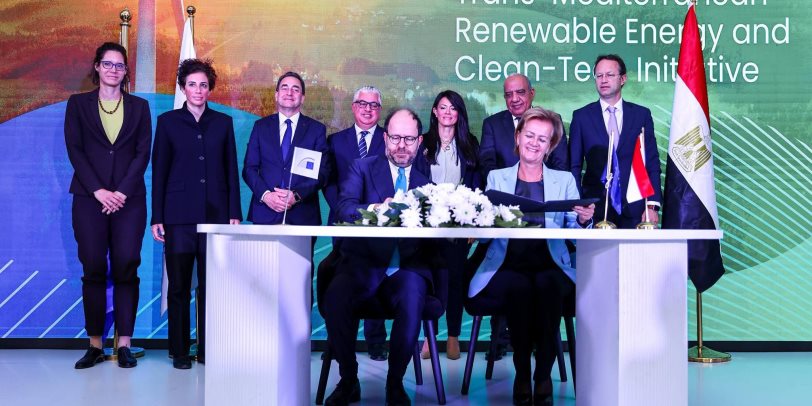
The European Union (EU) has signed two grants worth €125 million to enhance renewable energy capabilities in Egypt and support the green ammonia project in Ain Sokhna.
The EU signed a €90 million grant managed by the European Investment Bank, aimed at boosting investments in Egypt’s electricity network and developing renewable energy capacities.
Additionally, a €35 million grant was awarded to the Norwegian company Scatec for the green ammonia project in Ain Sokhna.
Rania Al-Mashat, Minister of Planning, Economic Development, and International Cooperation, emphasized that the transition to sustainable, secure, and efficient energy systems is a key driver for achieving comprehensive development in Egypt.
This aligns with the national development narrative aimed at achieving sustainable economic growth, enhancing the economy's competitiveness, and committing to climate action goals.
She added that Egypt has adopted an ambitious energy vision through 2040, focusing on expanding renewable energy sources, improving energy efficiency, and maximizing the use of diverse resources.
This vision strengthens Egypt's position as a regional energy hub in the Eastern Mediterranean and supports the achievement of sustainable development goals.
The Minister also highlighted that the strategic and comprehensive partnership launched between Egypt and the EU in March 2024 marked a turning point in bilateral relations, as it represents the highest level of partnerships the EU forms with countries worldwide.
The energy sector plays a central role in this partnership, with integrated funding packages, investment guarantees, and technical support.
She noted that the Ministry of Planning, Economic Development, and International Cooperation plays a pivotal role in coordinating international partnerships and ensuring that investments align with national priorities, especially the transformation in the energy sector.
This includes close cooperation with European funding institutions, notably the European Investment Bank and the European Bank for Reconstruction and Development.
In this context, the Minister presented the NWFE platform as a leading national model for integration between the water, food, and energy sectors.
Over three years, the program successfully mobilized around $5 billion to implement renewable energy projects totaling 4.2 GW through the private sector, reinforcing Egypt’s role as a regional model for climate finance and green development.
She also highlighted the importance of the "European Sustainable Development Fund Plus" (EFSD+) mechanism in stimulating European investments in Egypt, particularly in renewable energy, green hydrogen, energy efficiency, and electricity network upgrades, as well as the (T-MED) initiative for Mediterranean cooperation in clean energy and technology.
The Minister concluded by emphasizing that the energy sector transformation is a crucial part of Egypt’s national development narrative, which integrates economic policies, investment in human capital, private sector empowerment, and green transformation, ensuring inclusive and sustainable growth while enhancing the Egyptian economy’s resilience to global shocks.