The project aims to produce one million tons of green ammonia annually in three phases, starting in 2029.
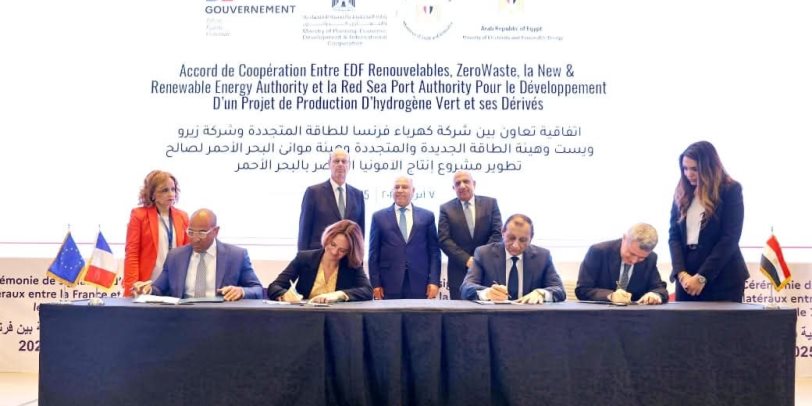
Egypt and France has signed an agreement to develop an integrated green hydrogen and derivatives production facility, including green ammonia, in the Ras Shukeir region.
The total investment across the project’s three phases is expected to reach €7 billion, with a target annual production capacity of one million tons. The entire investment will be funded by the project company.
The project aims to produce one million tons of green ammonia annually in three phases, starting in 2029.
EDF Renewables and Zero Waste will jointly invest €2 billion in the project’s first phase, which aims to produce 300,000 tons of green ammonia annually.
The entire three-phase investment is projected to reach €7 billion to achieve the targeted one million tons per year.
A preliminary feasibility study has been completed, outlining project requirements. A total of 368 km² has been allocated for solar and wind energy generation across the three phases in Ras Shukeir, along with 1.2 million m² for the manufacturing facility.
The project will also include a 7-kilometer transmission corridor and the construction of a seawater desalination unit to supply water for all phases.
The company will also finance and build a 400-meter-long, 17-meter-deep loading berth at the Red Sea port, fully equipped with necessary infrastructure.
Deputy Prime Minister for Industrial Development and Minister of Industry and Transport, Kamel Al-Wazir, noted that the project is apart from similar initiatives by being fully private-sector funded, requiring no public infrastructure or reliance on the national electricity grid.
As a rare 100% private initiative, the project will require partners with robust financial and technical capacity, as it involves a long-term investment horizon of up to 50 years.
The Ministry of Transport will coordinate with all relevant ministries and regulatory bodies to ensure the completion of all legal procedures and approvals necessary for the project's successful execution, in line with required standards.
The project is expected to generate direct economic returns through service fees collected by the project company, licensing fees, land-use charges for solar and wind power generation, and facilities for hydrogen and ammonia production.
Egypt will also benefit from export duties on each ton shipped and various taxes—all to be paid in foreign currency.
Indirect benefits include job creation throughout the construction and operational phases, with the project offering a wide range of employment opportunities.
The project aims to localize key manufacturing components such as electrolyzers, solar panels, and wind turbines, boosting domestic production capabilities.
It will also support green fuel bunkering for ships passing through the Suez Canal, helping Egypt stay ahead of global maritime and environmental shifts.
The project company will be responsible for training and qualifying Egyptian workers, aiming for up to 95% local labor participation in direct roles—contributing to the development of a skilled national workforce in clean energy.