Al-Mashat highlighted the government’s commitment to investing in Upper Egypt, with EGP 62.4 billion allocated to the region in the current fiscal year, 11% of which is directed to Minya
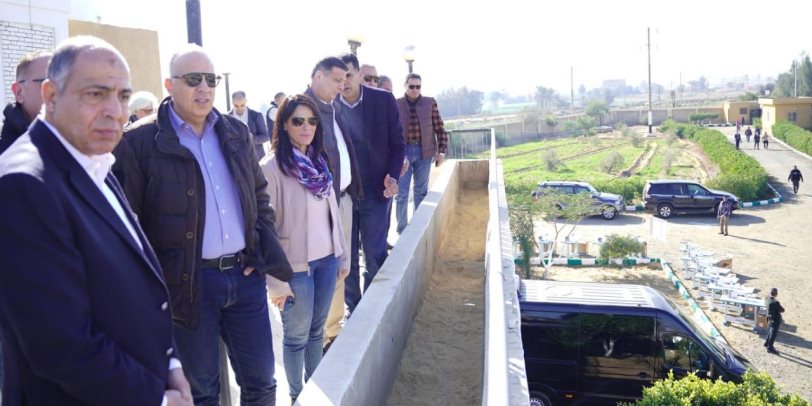
Minister of Planning, Economic Development, and International Cooperation, Rania Al-Mashat, visited the activities under Minya's Sustainable Agriculture Investments and Livelihoods (SAIL) project.
Al-Mashat highlighted the government’s commitment to investing in Upper Egypt, with EGP 62.4 billion allocated to the region in the current fiscal year, 11% of which is directed to Minya. Additionally, as part of the first phase of the presidential Decent Life initiative, EGP 43.2 billion has been invested in Minya across various sectors.
The Minister noted that agriculture plays a critical role in Egypt’s economy, contributing 12% to the GDP. Enhancing sustainability in agriculture and irrigation not only fosters economic growth but also creates job opportunities for local communities.
The project also prioritizes capacity building, having trained 240 stakeholders across governorates to address the needs of smallholder farmers. Furthermore, 125 local beneficiaries have been trained in climate-smart agricultural practices and natural resource management. To date, 66 field schools have been implemented, along with training programs for managers and supervisors.
Accompanied by Minister of Irrigation and Water Resources, Hani Sweilem, Minister of Agriculture and Land Reclamation, Alaa Farouk, and the Governor of Minya, Al-Mashat inspected key projects aimed at enhancing agricultural sustainability and improving livelihoods in the West Samalut area.
The visit included a review of advanced irrigation systems, solar power stations, and models of agricultural and field schools. The Minister underscored the significance of these initiatives, implemented in partnership with the International Fund for Agricultural Development (IFAD) and the Food and Agriculture Organization (FAO), in driving rural development, improving the lives of smallholder farmers, and creating job opportunities.
Al-Mashat emphasized the project’s alignment with Egypt's integrated partnership with the United Nations, which leverages collaborative programs across UN agencies to achieve comprehensive development goals. She highlighted the importance of transitioning to modern irrigation methods, such as drip irrigation powered by solar energy, to optimize water resources and boost agricultural productivity.
Among the project’s notable achievements, 1,248 feddans along the Tarfa irrigation line in West Samalut have been upgraded from flood irrigation to drip irrigation using solar energy. Additional irrigation upgrades are underway for Station 12 and Station 13, covering 2,160 feddans, as well as Station Zero, which spans 981 feddans. Work is also ongoing on two branches of the Tarfa line, covering a total of 1,105 feddans.
The project has installed 12 solar energy units for irrigation at Station 14 in Minya, along with 40 solar-powered pumps across Upper Egypt, converting 675 feddans across 135 farms from traditional flood irrigation to drip irrigation.
In collaboration with FAO, 172 new Farmer Field Schools (FFS) are being established in the project areas. These schools focus on participatory learning and market-based agricultural guidance, covering areas such as plant and animal farming, as well as climate change adaptation.