The company aims to establish a complete supply chain in Egypt, starting with yarn production, progressing to fabric manufacturing, and ending with garment production
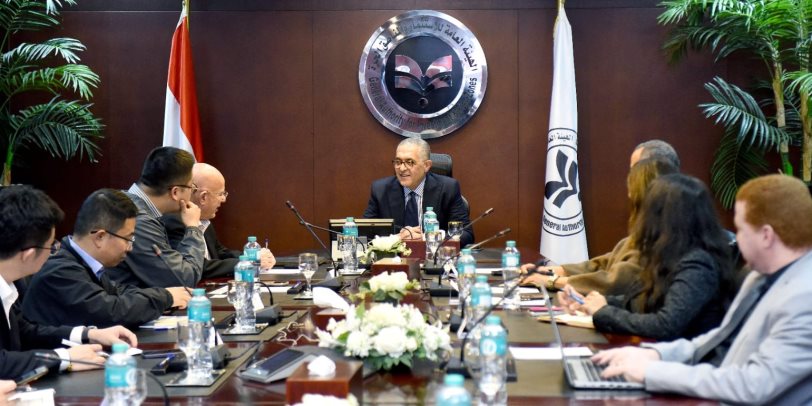
The General Authority for Investment and Free Zones (GAFI) has announced that Lutai Group, the world’s largest producer of dyed fabrics and shirts, is planning to establish its first factory in Egypt. The proposed facility, which will span 500,000 square meters, represents an investment of $385 million. CEO of GAFI, Hossam Heiba, met with a delegation from Lutai Group to discuss the company’s plans.
Lutai Group’s Global Marketing Director, Liu Deming, stated that the company aims to establish a complete supply chain in Egypt, starting with yarn production, progressing to fabric manufacturing, and ending with garment production. He highlighted that 100% of the output will be exported, aligning with the Ministry of Investment and Foreign Trade’s strategy to attract investments focused on exports.
He further emphasized that Lutai Group plans to introduce advanced technological expertise to Egypt, leveraging the company’s state-of-the-art spinning systems—the most advanced globally. The company, which has won China’s National Science and Technology Award four times, is committed to innovation and product improvement. This expertise, Liu noted, will enhance Egypt’s competitiveness in global textile markets as Lutai begins operations.
Deming added that Egypt provides an ideal environment for investment, citing economic stability, sustained growth, and the availability of a well-trained workforce. He also pointed out the strong bilateral relations between Egypt and China, which facilitate the flow of Chinese investments into the country.
GAFI CEO highlighted Egypt’s strong investment climate, supported by the Investment Law and its executive regulations, which serve as catalysts for foreign investors. He noted that Egypt’s economic growth consistently outpaces regional averages and benefits from a highly skilled labor force. He also pointed to Egypt’s strategic trade agreements, which provide access to markets with over 3 billion people globally, and its competitive construction and utility costs, among the lowest worldwide.
Heiba explained that GAFI tailors its investment incentives to meet the needs of individual projects. He confirmed that Lutai Group is eligible for the maximum financial and regulatory incentives under the Investment Law. The company’s plans align with Egypt’s developmental priorities, including technology localization, labor-intensive projects, export-focused investments, and development of underserved areas. Additionally, Lutai’s new factory qualifies for Egypt’s Golden License, a comprehensive approval covering all required permits for full operational launch, issued within just 20 working days.
Chairman of the Egyptian Exporters Association (Expolink), Mohamed Kassem, noted that Egypt’s textile, garment, and fabric sectors are witnessing significant foreign investment inflows, particularly from China. He attributed this to the global restructuring of supply chains, as investors seek proximity to key markets. Kassem emphasized that Egypt’s economic reform program further enhances the competitiveness of its exports in these sectors, presenting substantial growth opportunities for the country.