
The Suez Canal remains the world's most crucial maritime route.
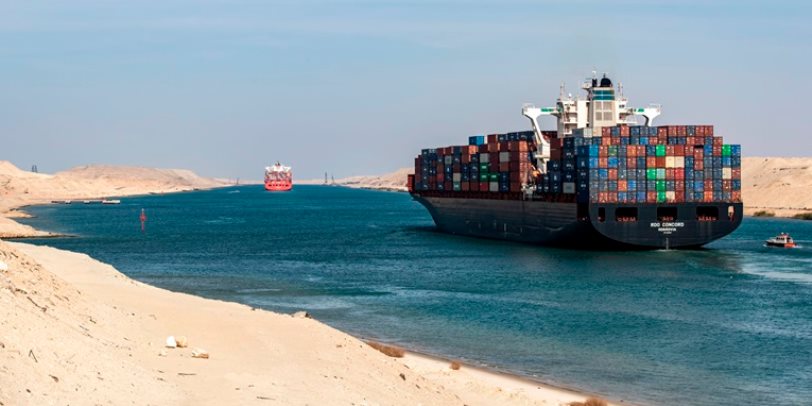 Suez Canal remains the world's most crucial maritime route - File Photo
Amid escalating tensions in the region, the Suez Canal remains the world's most crucial maritime route, not only as the shortest link between East and West but also environmentally, by saving time and distance compared to alternative routes.
International data and statistics indicate that the Suez Canal route contributes to reducing fuel consumption by percentages ranging from 10% to 90%, depending on port departure and arrival, resulting in a reduction in harmful carbon emissions. In 2023, the Suez Canal helped cut carbon emissions by 55.4 million tons, saving fuel consumption by 16.9 million tons.
Efforts for development and modernization continue in the Suez Canal, including new maritime services such as fuel supply, maritime ambulance service, maritime rescue, pollution control, ship repair, and maintenance services. The Suez Shipyard Company, affiliated with the authority, recently repaired the ship "ZOGRAFIA" after it was attacked in the Red Sea.
Lt. Gen. Osama Rabie, Chairman of the Suez Canal Authority, held several meetings with international organizations concerned with international navigation, notably a meeting with Arsenio Dominguez, Secretary-General of the International Maritime Organization (IMO), via video conference to discuss developments in the Red Sea and the Bab el-Mandeb Strait.
They also discussed mechanisms for cooperation to mitigate the crisis's impact on global supply chains and maritime shipping.
The Chairman reiterated his commitment to continued cooperation and joint coordination with the IMO, aiming at initiatives and recommendations benefiting the international maritime community, particularly those focusing on environmental conservation and reducing harmful carbon emissions from ships. He emphasized that the current situation foreshadows an exacerbation of harmful carbon emissions as ships consume more fuel when taking alternative routes and sailing for longer distances and durations than usual.
The Chairman emphasized that navigation through the canal is regular and has never stopped for a single day since the crisis erupted. The Suez Canal continues to provide its maritime services normally, alongside the authority's efforts to support its clients in mitigating the current situation's impact on them.